Brian’s Story

A while ago a friend and I were walking in Sutton Park one Sunday afternoon when someone said: “Brian?” I looked towards the man and his wife, racked my brain to remember a name and said “Hello Fred (not his real name), long time, no see” I hadn’t seen him or his wife for several years but one glance at his wife told me a lot. We chatted generally, avoiding the elephant in the room and agreed to meet up the following week. He had early signs of carer burn out, he was struggling with life. He didn’t tell me, so how did I know? Because I had been there.
This is very much my story but I hope bits of it will resonate with some of you. It’s not a lecture about what to do and what not to do when you become a caregiver. I’m also not about to tell you how to be a good or a bad caregiver. I’m not even sure which of those I was, In all probability a bit like the curates egg, good in parts.
Everybody’s experience of being a caregiver will be different. There are so many variables which impact on the situation that there is no “One size, fits all” solution. This isn’t about the patient although she will be mentioned a lot but it’s about being a caregiver, that often unsung, unrecognised and unrewarded role that nearly 7 million people are performing at anyone time.
The story isn’t about cancer. I became a volunteer here at the Cancer Centre having survived grade three bowel cancer myself, the removal of a significant part of my bowel and having gone through the difficult challenges of months of chemotherapy plus some of the longer term effects. With time on my hands I decided to join this lovely organisation to see if perhaps I could give something back to the system that saved me.
This is about my late my wife, some of the challenges I faced and some of the things I learned while looking after her at one level or another for the best part of 13 years.
Caring for someone is something that you can be proud of, being able to help someone through a difficult period in their life is something that you should look back upon with pride.
I knew that my wife had conditions that were progressive. I’m not sure that I fully grasped what progressive meant in those early days as I concentrated getting her through each day. Maybe it was my way of not dealing with what was inevitably going to happen. In fairness had I focussed on that I may well have failed with the task in hand.
She loved her home and her family (and her dogs). I always knew that she hated hospital, despite working in one. Actually that may be a good enough reason. I knew that if it was possible then my role was to keep her at home and out of an institution as long as possible.
After everything that went on during those years she passed away peacefully at home with her beloved dog on the bed beside her and her family by her side. Although we never discussed it I know it would have been what she wanted and whatever the journey, at least I got her to her preferred last stop on her journey. I had done the best I could. It may seem like a small win but I took a lot from that in the grieving process that followed but that’s another story.
I was asked about my experiences as a caregiver.
It was only when I sat down to make some notes that I found how difficult it was to put into words. My natural instinct as a caregiver was to try to shield and protect others from the situation and pain that we were facing, so I had buried this deep down. I’m not sure if this just a male way of dealing with things but it fitted with my wife’s fight and determination. Longer term though there is a cost to pay which catches up with you.
My wife had been struggling for a while including significant issues of tiredness. As she told me, her get up and go had got up and gone. She was eventually diagnosed with MS initially but things got progressively more complicated over the next thirteen years.
There followed a cocktail of neurological problems over the subsequent years. Notably Parkinson’s (all five stages of it), Dystonia, Epilepsy, Trigeminal neuralgia (from which she was in virtual constant pain) and towards the end, Dementia brought about by the Parkinson’s.
Whilst none of these were cancer related and different conditions provide different challenges to each caregiver, much unites us as we care for, support and look after a loved one.
There are many other things that unite us caregivers too, such as anger, worry, frustration, hurt, self doubt, fear, anxiety, exhaustion, stress, isolation, helplessness, sleeplessness, depression, illness, to name but a few. All of which need to be addressed if we want to function properly as a caregiver.
As the author of a book that I will recommend later said “ Being a caregiver can be Stressful, demanding, emotional and lonely”
You may have noticed that I use the term caregiver rather than carer. I do this because the word carer is often used to describe both us individuals and the army of professional carers who arrive at peoples houses to bathe, dress and medicate those who can’t manage to look after themselves.
I believe that they are two separate identities
Being a caregiver is about us, the untrained, unprepared and often unappreciated amateurs.
What separates us from the professionals is that we are often caring for a loved one, a role that you can’t easily walk away from, a role you can never switch off from wrapped up in the emotional impact on your life, both currently and maybe in the future too.
Not only can the role be physically draining but often emotionally draining too, it is 24 hours a day, 7 days a week and 365 days a year often without any meaningful respite. Every day you are trying to be positive, upbeat, enthusiastic and supportive often to someone who neither feels nor appreciates any of these things. It is truly a role that will only be fully understood by someone who has walked a mile in a caregiver’s shoes. It’s the emotional tie that makes all the difference.
It took me a long time to understand that you need to view the situation from the patient’s perspective as well as your own. Whilst I could feel and experience the impact on me it took me a while to realise that I needed to view things through my wife’s eyes as well. I could never understand or appreciate her situation properly but by trying to put myself in her shoes I started to empathise with some of her attitudes, frustrations and reactions in certain situations. An example of this was getting the Power of Attorney forms completed. To me a sensible precaution irrespective of your current state of health. To my wife it was a sign that I had given up on her and if she refused to sign the papers it would mean she would be ok.
So a seemingly perfectly healthy person is told that they have a serious illness. Mentally they have to deal with the loss of control over their own life which they have fought for since childhood, the diagnosis, the prognosis, possibly facing their own mortality for the first time, being absolutely frightened about what is going to happen. [I remember only too well that moment that I was told that I had cancer] Then there are the physical aspects of the condition, their loss of independence, concerns about the future, not being able to do normal things, being resentful about needing care, reacting adversely to drugs and treatment plus a whole lot more. Who will bear the brunt of that?
Yet as the caregiver have your own issues. You are watching a loved one suffering, being unable to put things right, unable in many cases to reassure with any confidence. There are worries about actually doing a good job as a caregiver with all that may entail, worries about prognosis, facing own mortality, financial worries, impact on career plus much more.
It’s a boiling cauldron, that would test any relationship.
Interestingly, having had some involvement in personality profiling it is recognised that apart from our dominant personality, whichever type it is, when under pressure our personality type will change. Just think of occasions in your own life when you have acted out of character. I obviously excluding alcohol or any other stimulant!
If you apply that logic to a patient/caregiver relationship then with both of you being under pressure it is possible that you have both undergone a change in your character types, almost like two strangers relating to each other.
Becoming a caregiver is something that most of us don’t give much thought about until you become one. In fact most of us don’t give much thought until some time after we have become one, often having not realised that we have made that transition. After all many of us did utter those words “ in sickness and in health” without ever really considering on our happy day that, at some stage, you might have to live up to the promise. Some will think “how hard can that be, I already do everything that needs doing”. And for some it won’t be hard. For others it will be difficult. For others one of the most challenging things that you will have ever done.
I described the situation to someone that being a caregiver felt like being in a submarine.
Life to that moment had been like being on an ocean going liner gliding along with occasional choppy seas and poor weather. When you become a carergiver you swap the mode of transport for a submarine. You remain on your journey but don’t make the speed of the liner and you wallow a little as the swells start to impact you. To avoid the turbulence you dive beneath the waters. You descend slowly but then you find that you can’t stop that descent. Sometimes its stable, sometimes it’s rapid and other times it’s slow but the descent continues. As the submarine sinks slowly the pressure starts to increase unless you can find someway of controlling, slowing or stopping the descent. The descent continues, the pressures stress the hull. The descent continues, the pressure continues to increase. Things inside become more uncomfortable you become anxious, under pressure yourself, no one outside can help, the seams start letting in drips of water, the descent continues, the pressure increases and the drips become leaks until suddenly the vessel can’t cope………..
That describes what happened to us
Both second time around marriages we had started a new life together ten years previously. I was working in a career that I loved with my wife happy working at the local hospital. Our two sets of kids got on. We were enjoying life.
The MS diagnosis in 2006 was a shock but explained a few things. Initially there were some things that were difficult for her and I suppose that’s when the caring role started but my mum had prepared me well domestically as you would expect from a girl with four brothers who had everything done for them!
I was diagnosed with cancer on Xmas Eve that year, operated on in Jan. My wife was involved in a car crash three days after my op which left both of us hospitalised. I got out first to help her but my first shopping trip was an unpleasant experience whilst nursing my operation scar having been cut from breast to pubic bone. Some would say I was daft and stubborn, I think they were right.
Other unexplained problems started appearing. Her Parkinson’s diagnosis in 2008 at least put a name to them. This created some real problems for us as her Parkinson’s medication had to be given exactly at four hourly intervals. We were ok while my wife could self administer but that didn’t last for long. Luckily from my perspective I worked from a home base but I had national responsibility for a team of forty plus people. My wife had to retire from work on health grounds.
As she became less able some friends and acquaintances jumped ship as they simply didn’t know how to cope with our situation. I understand the expression of fair weather friends a whole lot more nowadays.
In 2010 she developed a fairly rare neurological condition called Dystonia. Her right leg became distorted making walking a massive problem and the frequency of falls increased. I started getting calls when around the country, (relying on neighbours to help out) saying she had fallen and was in A and E.
In June 2013 I had a heart attack which changed the environment.
Two days later I signed myself out of hospital because I couldn’t see what else to do. The family tried to help but they had responsibilities too and I was too stubborn, insisting that I could cope. That’s what caregivers often do, taking the back seat, always putting the needs of others first.
We got through that but my wife’s night time discomfort and restlessness meant that for literally years I didn’t have a full nights sleep. On several occasions I never slept at all for over thirty hours and was still trying to work. One Easter Sunday because of her continued discomfort I lifted her from sitting to standing, holding her up for a minute or so before putting her back down over 100 times that day, I stopped counting then.
So what about the family? I tried to protect both sets of children from the worst of the situation. They had their own lives and commitments.
Following a diagnosis of epilepsy yet more medication was added, she was now on 28 tablets a day and 4 patches plus paracetamol as required. It was a questionable cocktail.
The pressure at home never let up, one day merged with the next, Hospital appointments increased as did hospital admissions and hospital visits. Plenty of professionals visited at home, the vast majority of whom were ineffectual.
I’m embarrassed to admit this next point but I told you earlier that I recognised the signs of caregiver burnout. I’m not proud of it but her health and behaviour became so erratic that following a particularly difficult 48 hours (too complicated to explain succinctly) I took my wife, in her wheelchair, into A and E, went to the nurses station and handed over a bag of medication and some contact details and said “I can’t go on, she’s your problem now”. I turned my back and walked out. The nurse never attempted to stop me. I was later told that I wasn’t the first caregiver to do this and wouldn’t be the last .
The story doesn’t finish there
I told the children where she was and didn’t go back to the hospital for several days, until one of her consultants rang me and asked me to pop in to see him for a chat. He told me that she had had a mental breakdown to put it simply and spent a month or more in a psychiatric unit on the other side of the city.
Guilt wracked me, the whole helplessness of what was to come continued to gnaw at me. We all want to care for our loved ones but sometimes you can’t achieve the impossible but you can’t tell yourself that. You try and do your best and doubt yourself constantly.
I visited her every night, just for the timed hour permitted
She returned home.
I’d had some element of respite, with a greater awareness in the family of what actually was going on.
At that stage I told my company that I was going to take early retirement giving them six months notice to find a replacement.
Dementia set in and she didn’t know who I was or anyone else although friends had long gone, and understandably family didn’t want the children to see her in that state.
The pressure finally cracked the hull as six months later my wife passed away. I was lucky, I wasn’t crushed but it took me two years to come to terms with that period and it was only then that I felt able to move forward.
As a caregiver you protect your loved one, you protect your family, you attend their every need, you ignore the physical and mental cost to yourself. You wake up, do everything, try to keep things normal, run the home, deal with everything. You put yourself last.
Most friends that you thought that you could count on you can’t. You go without sleep, you go without a holiday, a break. You just don’t think about yourself.
You live with the proverbial sword of Damacles hanging over your head. You worry about what will or won’t happen. You are unable to control things.
There is no escape
But…….. amongst the details of this torrid time I had two people who I could talk honestly who listened, were non judgemental and who got me through this event damaged but repairable over time . Without them I could not have survived. I didn’t let them in early on because I felt that I should cope. I lied and made things sound far better than they were. It was only when I told them the true story and I let them in did I start to offload. They got me through. If I have one piece of advice to anyone who is in the pressurised environment of being a caregiver please share with someone you can trust.
Let me sign off with some final words of advice. They are simple to say but harder to do but they add so much to your caregiver survival kit:
My first lesson was you can only deal with what’s in front of you, don’t overthink things.
Concentrate on the journey and not on the destination
My second word of advice if you are dealing with various outside agencies and the Health Service is to keep records of everything. It always seemed to me that these agencies never communicated with each other. The reality I am told is that most professionals often don’t have time to read the backstory in detail before seeing you because they are so overworked
My third lesson is to share your situation, warts an all with someone that you trust. Be totally honest even at the risk of embarrassment to yourself. That’s a massive move to most people especially us men. It is not a sign of weakness or an admission of failure. It’s a way of organising your thoughts and emotions and the chance to let some of the pressure that builds up inside dissipate a little. Often talking to a good listener and someone you feel completely at ease with doesn’t require smart answers just good questions.
Lesson Four. Try and imagine walking the proverbial mile in the patients shoes Try to imagine how you might feel if it had been you that had been given a potentially life changing diagnosis.
5) Don’t beat yourself up, you will get things wrong, you can’t control everything. Be kind to yourself. Even superheroes have Kryptonyte.
6) If you are working let the organisation know what you are having to deal with. Give them a heads up early on and update them if the situation changes.
7) Let your GP know that you are a caregiver, they do understand the enormous strain that can come with that responsibility and can be helpful.
8) Be kind to yourself – you didn’t choose this role, it chose you, don’t blame yourself for everything that doesn’t go according to plan.
9) Make daily time to get out of the caring environment, to clear your head and recharge the batteries. You need at least an hour
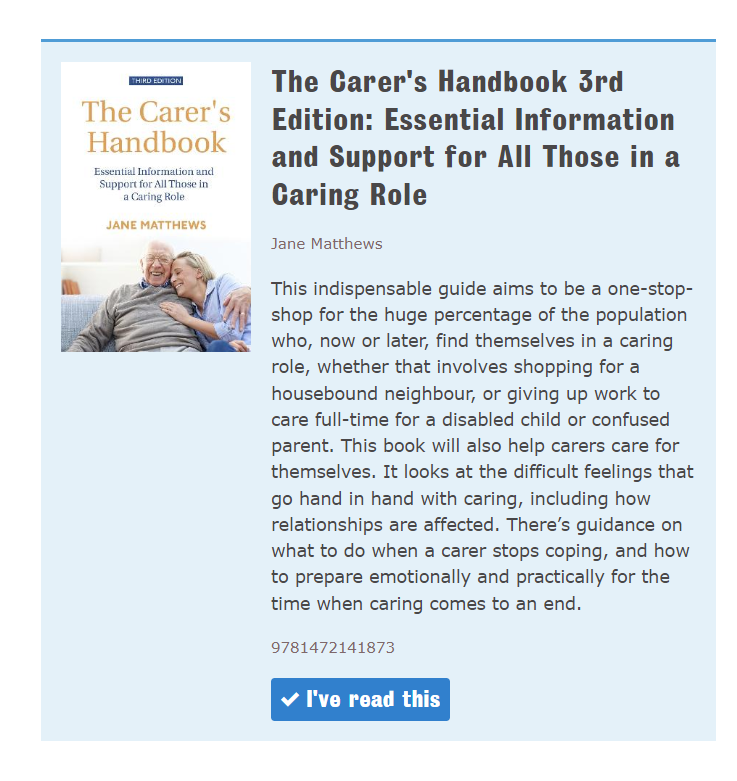
10) Read this book, details below. It’s written by someone who knows.
11) Or come along to the caregivers group where you will meet people maybe in similar positions or who have been there where you can be amongst people who really understand what being a caregiver involves. We’ve also got copies of this excellent book in our library that you can join.
Thank you for putting up with me, I hope I’ve not frightened you. I hope I’ve not put you off because as I said previously caring for a loved one can also be both hugely rewarding and life affirming.